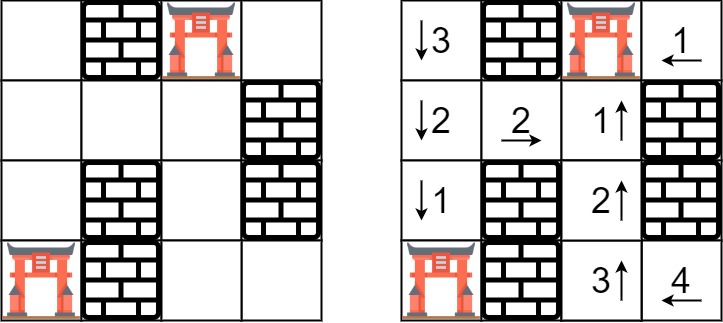
Approach #1 (Brute Force) [Time Limit Exceeded]
The brute force approach is simple, we just implement a breadth-first search from each empty room to its nearest gate.
While we are doing the search, we use a 2D array called distance
to keep track of the distance from the starting point. It also
implicitly tell us whether a position had been visited so it won't be
inserted into the queue again.
private static final int EMPTY = Integer.MAX_VALUE;
private static final int GATE = 0;
private static final int WALL = -1;
private static final List<int[]> DIRECTIONS = Arrays.asList(
        new int[] { 1,  0},
        new int[] {-1,  0},
        new int[] { 0,  1},
        new int[] { 0, -1}
);

public void wallsAndGates(int[][] rooms) {
    if (rooms.length == 0) return;
    for (int row = 0; row < rooms.length; row++) {
        for (int col = 0; col < rooms[0].length; col++) {
            if (rooms[row][col] == EMPTY) {
                rooms[row][col] = distanceToNearestGate(rooms, row, col);
            }
        }
    }
}

private int distanceToNearestGate(int[][] rooms, int startRow, int startCol) {
    int m = rooms.length;
    int n = rooms[0].length;
    int[][] distance = new int[m][n];
    Queue<int[]> q = new LinkedList<>();
    q.add(new int[] { startRow, startCol });
    while (!q.isEmpty()) {
        int[] point = q.poll();
        int row = point[0];
        int col = point[1];
        for (int[] direction : DIRECTIONS) {
            int r = row + direction[0];
            int c = col + direction[1];
            if (r < 0 || c < 0 || r >= m || c >= n || rooms[r][c] == WALL
                    || distance[r][c] != 0) {
                continue;
            }
            distance[r][c] = distance[row][col] + 1;
            if (rooms[r][c] == GATE) {
                return distance[r][c];
            }
            q.add(new int[] { r, c });
        }
    }
    return Integer.MAX_VALUE;
}
Complexity analysis
-
Time complexity : O(m2n2).
For each point in the m×n size grid, the gate could be at most m×n steps away.
-
Space complexity : O(mn).
The space complexity depends on the queue's size. Since we won't insert
points that have been visited before into the queue, we insert at most m×n points into the queue.
Approach #2 (Breadth-first Search) [Accepted]
Instead of searching from an empty room to the gates, how about
searching the other way round? In other words, we initiate breadth-first
search (BFS) from all gates at the same time. Since BFS guarantees that
we search all rooms of distance d before searching rooms of distance d + 1, the distance to an empty room must be the shortest.
private static final int EMPTY = Integer.MAX_VALUE;
private static final int GATE = 0;
private static final List<int[]> DIRECTIONS = Arrays.asList(
        new int[] { 1,  0},
        new int[] {-1,  0},
        new int[] { 0,  1},
        new int[] { 0, -1}
);

public void wallsAndGates(int[][] rooms) {
    int m = rooms.length;
    if (m == 0) return;
    int n = rooms[0].length;
    Queue<int[]> q = new LinkedList<>();
    for (int row = 0; row < m; row++) {
        for (int col = 0; col < n; col++) {
            if (rooms[row][col] == GATE) {
                q.add(new int[] { row, col });
            }
        }
    }
    while (!q.isEmpty()) {
        int[] point = q.poll();
        int row = point[0];
        int col = point[1];
        for (int[] direction : DIRECTIONS) {
            int r = row + direction[0];
            int c = col + direction[1];
            if (r < 0 || c < 0 || r >= m || c >= n || rooms[r][c] != EMPTY) {
                continue;
            }
            rooms[r][c] = rooms[row][col] + 1;
            q.add(new int[] { r, c });
        }
    }
}
Complexity analysis
-
Time complexity : O(mn).
If you are having difficulty to derive the time complexity, start simple.
Let us start with the case with only one gate. The breadth-first search takes at most m×n steps to reach all rooms, therefore the time complexity is O(mn). But what if you are doing breadth-first search from k gates?
Once we set a room's distance, we are basically marking it as
visited, which means each room is visited at most once. Therefore, the
time complexity does not depend on the number of gates and is O(mn).
-
Space complexity : O(mn).
The space complexity depends on the queue's size. We insert at most m×n points into the queue.