Back to writing

19. Remove Nth Node From End Of List

19. Remove Nth Node From End of List

Medium


Given the head of a linked list, remove the nth node from the end of the list and return its head.


Example 1:
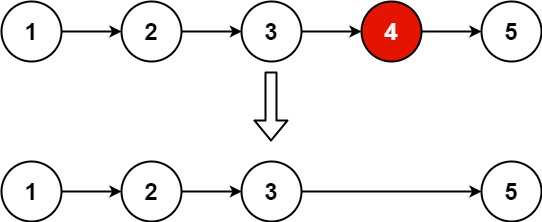
Input: head = [1,2,3,4,5], n = 2
Output: [1,2,3,5]

Example 2:

Input: head = [1], n = 1
Output: []

Example 3:

Input: head = [1,2], n = 1
Output: [1]


Constraints:

  • The number of nodes in the list is sz.
  • 1 <= sz <= 30
  • 0 <= Node.val <= 100
  • 1 <= n <= sz


Follow up: Could you do this in one pass?


 # Definition for singly-linked list.
# class ListNode:
#     def __init__(self, val=0, next=None):
#         self.val = val
#         self.next = next
class Solution:
    def removeNthFromEnd(self, head: Optional[ListNode], n: int) -> Optional[ListNode]:
#         size = 0
#         node = head
#         while node:
#             size+=1
#             node = node.next

#         node = head
#         target_node_position = size - n 

#         # head
#         if target_node_position == 0:
#             return head.next

#         target_node_position -=1

#         # head is removed, now the rest of them
#         for i in range(target_node_position+1):
#             if i == target_node_position:
#                 node.next = node.next.next
#             node = node.next

#         return head 

         # two pointer approach
        current_node = head
        for i in range(n):
            current_node=current_node.next

        if current_node is None:
            return head.next

        node_before_remove = head

        while current_node.next is not None:
            current_node = current_node.next
            node_before_remove = node_before_remove.next


        node_before_remove.next = node_before_remove.next.next

        return head

𝗦𝘆𝘀𝘁𝗲𝗺 𝗗𝗲𝘀𝗶𝗴𝗻 𝗞𝗲𝘆 𝗖𝗼𝗻𝗰𝗲𝗽𝘁𝘀:

  1. Scalability: https://lnkd.in/gpge_z76
  2. Latency vs Throughput: https://lnkd.in/g_amhAtN
  3. CAP Theorem: https://lnkd.in/g3hmVamx
  4. ACID Transactions: https://lnkd.in/gMe2JqaF
  5. Rate Limiting: https://lnkd.in/gWsTDR3m
  6. API Design: https://lnkd.in/ghYzrr8q
  7. Strong vs Eventual Consistency: https://lnkd.in/gJ-uXQXZ
  8. Distributed Tracing: https://lnkd.in/d6r5RdXG
  9. Sync vs Async Communication: https://lnkd.in/gC3F2nvr
  10. Batch vs Stream Processing: https://lnkd.in/g4_MzM4s
  11. Fault Tolerance: https://lnkd.in/dVJ6n3wA

𝗦𝘆𝘀𝘁𝗲𝗺 𝗗𝗲𝘀𝗶𝗴𝗻 𝗕𝘂𝗶𝗹𝗱𝗶𝗻𝗴 𝗕𝗹𝗼𝗰𝗸𝘀:

  1. Database: https://lnkd.in/gti8gjpz
  2. Horizontal vs Vertical Scaling: https://lnkd.in/gAH2e9du
  3. Caching: https://lnkd.in/gC9piQbJ
  4. Distributed Caching: https://lnkd.in/g7WKydNg
  5. Load Balancing: https://lnkd.in/gQaa8sXK
  6. SQL vs NoSQL: https://lnkd.in/g3WC_yxn
  7. Database Scaling: https://lnkd.in/gAXpSyWQ
  8. Data Replication: https://lnkd.in/gVAJxTpS
  9. Data Redundancy: https://lnkd.in/gNN7TF7n
  10. Database Sharding: https://lnkd.in/gMqqc6x9
  11. Database Indexes: https://lnkd.in/gCeshYVt
  12. Proxy Server: https://lnkd.in/gi8KnKS6
  13. WebSocket: https://lnkd.in/g76Gv2KQ
  14. API Gateway: https://lnkd.in/gnsJGJaM
  15. Message Queues: https://lnkd.in/gTzY6uk8

𝗔𝗿𝗰𝗵𝗶𝘁𝗲𝗰𝘁𝘂𝗿𝗮𝗹 𝗣𝗮𝘁𝘁𝗲𝗿𝗻𝘀:

  1. Event-Driven Architecture: https://lnkd.in/dp8CPvey
  2. Client-Server Architecture: https://lnkd.in/dAARQYzq
  3. Serverless Architecture: https://lnkd.in/gQNAXKkb
  4. Microservices Architecture: https://lnkd.in/gFXUrz_T

𝗟𝗼𝘄-𝗟𝗲𝘃𝗲𝗹 𝗗𝗲𝘀𝗶𝗴𝗻 𝗣𝗿𝗼𝗯𝗹𝗲𝗺𝘀:

  1. Design Parking Lot: https://lnkd.in/dQaAuFd2
  2. Design Splitwise: https://lnkd.in/dF5fBnex
  3. Design Chess Validator: https://lnkd.in/dfAQHvN4
  4. Design Distributed Queue | Kafka: https://lnkd.in/dQ6_B4_M

Share with someone who might need this.

FAANGTips